
What is Potential Energy Recovery? | EMC, ISO 9001, and CE Certified Hydraulic Valves – CML’s Global Recognition
Everything You Need to Know About Potential Energy Recovery! In 1981 Camel Precision Co.,Ltd was founded. The management of company fully awards of high quality products requires not only sophisticate machinery, But good knowledge in technology is also important as well. Company invited senior engineers from Germany and Japan to lead the manufacturing and training of local engineers in hydraulic industry. We offer our customers industrial pumps, solenoid directional control valves, hydraulic pumps, vane pumps, external gear pump, internal gear pump, directional valve, hydraulic valves...etc.
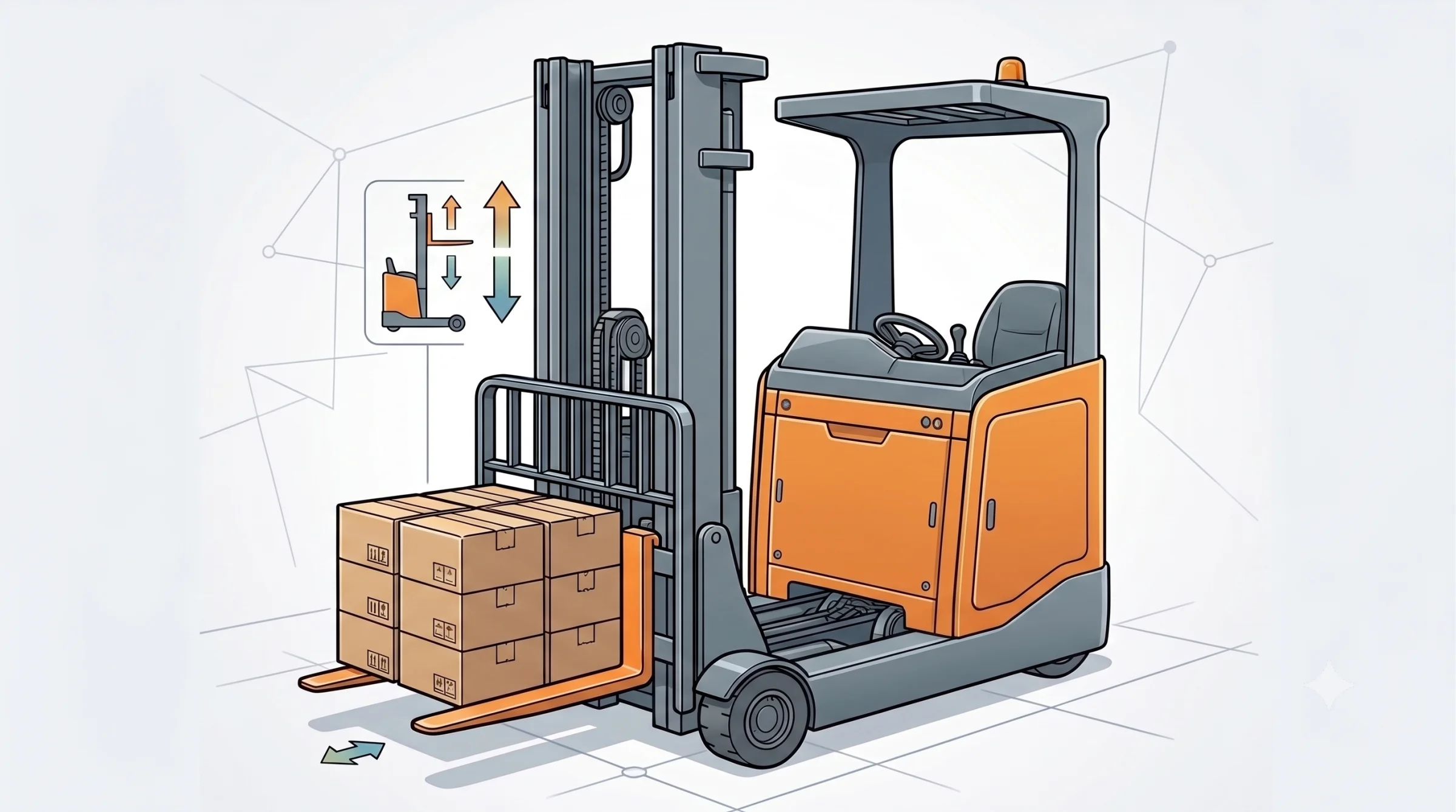
What is Potential Energy Recovery?
Everything You Need to Know About Potential Energy Recovery!
What is Potential Energy Recovery?
The public perception of traditional Internal Combustion forklifts—often referred to as diesel or gasoline forklifts depending on their fuel type—is usually associated with heavy noise and environmental issues. In standard forklift operations during mast lowering, oil from the hydraulic cylinder is discharged directly back into the tank, resulting in a waste of potential energy (Note 1). This is where the Potential Energy Recovery technology of electric forklifts becomes crucial for energy savings. Below, CML will introduce how this technology works.
Note 1: Potential energy is from an object based on its position or state that can be transformed and utilized.
How Potential Energy Recovery Works
Before diving into the energy recovery mechanism, it helps to understand how a forklift's forks raise and lower. This relies on the synchronized operation of the hydraulic system and the motor, which is split into two completely different physical processes:
Lifting Mode (Consuming Electrical Energy)
When the operator initiates a lift, the battery supplies electrical energy to the motor. The motor drives the hydraulic pump to do work, forcefully transferring hydraulic oil into the hydraulic cylinder. The pressure inside the hydraulic cylinder increases, pushing the plunger up to steadily lift the cargo. This process purely consumes electrical energy , but at the same time, potential energy is generated as the fork rises, the higher the more.
Lowering Mode (Releasing Gravity)
When the cargo/fork needs to be lowered, the system does not need to consume battery power to do so.
Traditional Forklift Approach: The system simply opens a release valve, allowing the hydraulic cylinder to lower while the hydraulic oil flows directly back into the oil tank. The motor and pump remain completely static, wasting the potential energy.
Potential Energy Recovery Approach: The system guides this returning pressured hydraulic oil back through the pump. The backpressure drives the pump to spin backward, which in turn pulls the drive motor into reverse rotation. This turns the motor into a generator (reverse power regeneration) turning gravity back into usable electrical energy!
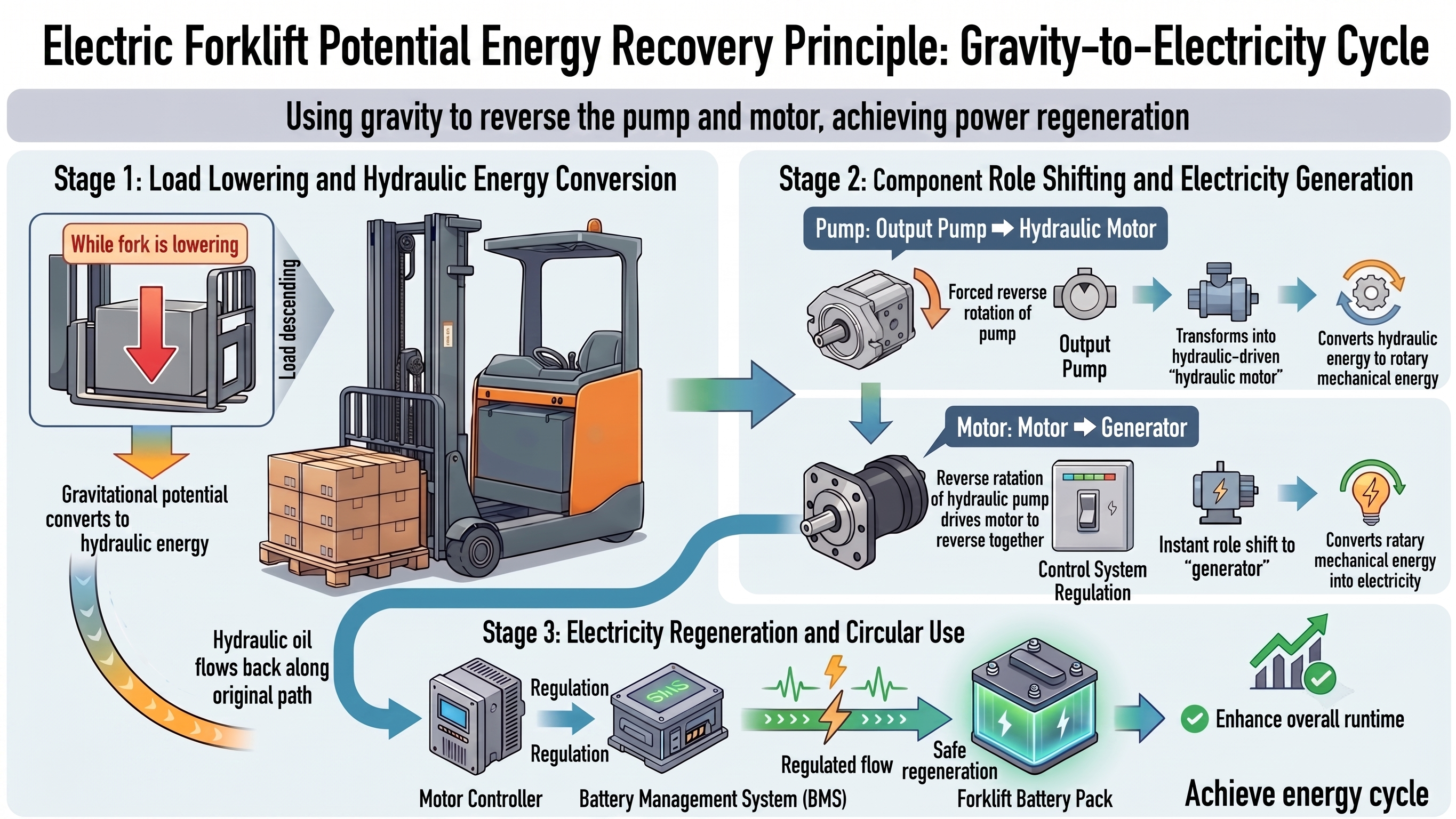
The potential energy recovery principle of an electric forklift relies on gravity to reverse the pump and motor, achieving energy regeneration. The roles of each component change as follows:
Important Considerations for Potential Energy Recovery
- High Lift/Head (Note 3): The higher the lifting height, the more potential energy is stored, leading to better recovery efficiency.
- Recovery Efficiency: While energy recovery effectively extends forklift runtime, actual energy-saving data will vary based on user scenarios. For instance, different warehouse shelf heights and varying picking positions will yield different recovery results.
- Battery Differences: The type of battery configured by the customer also directly impacts recovery efficiency; lithium batteries are much more efficient at accepting regenerative charge than traditional lead-acid batteries.
- Pump Hardware Limitations: Not all hydraulic pumps can perform this function. Traditional pumps cannot achieve potential energy recovery. This is where the reversible Eckerle pump stands out, making this capability its premier feature.
Note 3: "Head" or "Lift" represents the vertical height a hydraulic system or pump can push fluid (or lift an object via hydraulic pressure), subject to what applications the forklift is designed for. A high lift means the object is raised to a significant vertical height, such as a reach forklift.
Popular Products
 Download
 What is Potential Energy Recovery? | CML: ISO 9001 & CE Certified Hydraulic Pump Manufacturer – Award-Winning Quality
Located in Taiwan since 1981, Camel Precision Co., Ltd. is a hydraulic pumps and hydraulic valves manufacturer in Machinery and Equipment Manufacturing Industry.
In 1981 Camel Precision Co.,Ltd was founded. The management of company fully awards of high quality products requires not only sophisticate machinery, But good knowledge in technology is also important as well. Company invited senior engineers from Germany and Japan to lead the manufacturing and training of local engineers in hydraulic industry. We offer our customers industrial pumps, solenoid directional control valves, hydraulic pumps, vane pumps, external gear pump, internal gear pump, directional valve, hydraulic valves...etc.
CML, Camel Hydraulic, Camel Precision has been offering customers high-quality Vane Pump, Variable Displacement Vane Pump, Internal Gear Pump, Eckerle Asia Agent, External Gear Pump, Solenoid Valve, Modular Valve, Pressure Reducing Valve, Flow Control Valve, Hydraulic Valve since 1981, both with advanced technology and 38 years of experience, CML, Camel Hydraulic, Camel Precision ensures each customer's demands are met.
Company Facts in Numbers
0
Years of industry experience
0
Number of clients served
0%
Customer repurchase rate